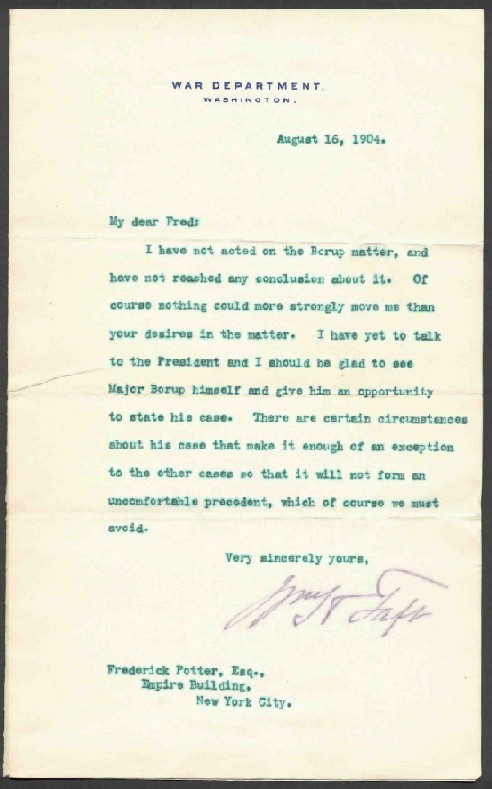
1904 Letter From Secretary of War William
Howard Taft Concerning Major Henry Borup and Aftermath of First Army
Intelligence Scandal
Letter To New York City Millionaire
Frederick Potter, Owner of Empire Building
This is an interesting letter from William
Howard Taft to a New York City millionaire Frederick Potter concerning the
"Borup matter" in which Taft says he has not yet seen President Theodore
Roosevelt about the matter and offers to "see Major Borup himself and give him
an opportunity to state his case." Naturally curious about what matter
would occupy the attention of the Secretary of War and President of the United
States in 1904, my search of the internet came up with this interesting
reference to Borup ten years earlier which might have been related to the
present "matter."
Although the introduction of attaches improved the
Army's foreign intelligence capabilities, it also resulted in the Army's first
intelligence scandal. In 1892 Capt. Henry T. Borup, the American attaché
posted to France, was expelled from the country for attempting to purchase the
plans for the fortifications of Toulon from a disgruntled employee of the
French Ministry of Marine. This event caused some consternation, especially to
Jefferson Coolidge, the American minister to France. Coolidge pointed out that
Borup's action had been "perfectly useless"; not only was America at peace
with France, but the small American navy could not attack Toulon. 16
However, the captain's behavior, while indiscreet, was not totally
irrational; the United States had recently embarked on a program to upgrade
its own coastal defenses, and Borup, an ordnance officer, presumably believed
that any information gleaned from abroad would be helpful. At any rate, this
minor embarrassment did not interfere with the growth of the attaché system.
By 1894 five additional attaché posts had been set up at other European
capitals, Japan, and Mexico. (See,
http://www.army.mil/cmh-pg/books/Lineage/mi/ch1.htm)
The entire text of the letter reads as
follows:
War Department, Washington stationary
August 16, 1904
My dear Fred:
I have not acted on the Borup matter, and have not reached any conclusion
about it. Of course nothing could more strongly moe me than your desires in
the matter. I have yet to talk to the President and I should be glad to see
Major Borup himself and give him an opportunity to state his case. There are
certain circumstances about his case that make it enought of an exception to
the other cases so that it will not form an uncomfortable precedent, which of
course we must avoid.
Very sincerely yours,
to Frederick Potter, Esq.
Empire Building
New York City
Championing Borup's cause was Frederick
Potter, an attorney who had inherited a fortune and owned a famous building to
which Taft could simply address his letter, "Empire Building."
1904 was an election year and millionaire could be very helpful to financing the Roosevelt
reelection effort so Taft addresses his letter to "My dear Fred" and is very
accommodating. Here is
some background on the Empire Building and Potter found on the internet:
EMPIRE
BUILDING,
71 Broadway (aka 69-73
Broadway, 1-5 Rector Street, and 51-53 Trinity Place) The richly decorative,
neo-classical Empire Building was commissioned in 1895 by the Estate of
Orlando B. Potter and constructed in 1897-98 to the design of Kimball &
Thompson. One
of the first skyscrapers on the west side of lower Broadway, the building
assisted in transforming the street into the "canyon" of masonry office towers
familiar to this day. An additional story, faced in terra cotta, was
constructed in 1928-30. The Empire Building served as the headquarters of the
titanic United States Steel Corp. from its formation in 1901 until 1976.
Orlando B. Potter
The Empire Building was commissioned
in 1895 by the Estate of Orlando B. Potter. A Massachusetts lawyer, Potter
(1823-1894) moved to New York City in 1853 to assist in the development of a
sewing machine business; he was president of the Domestic Sewing Machine Co.
until 1876. A prominent figure in New York Democratic politics, he achieved
recognition by developing a plan for a national banking system and currency
that was adopted by Congress in 1863, served as a U.S. Representative in
1883-85, and was a member of the Rapid Transit Commission in 1890-94. Potter
became extremely wealthy, due largely to his commercial real estate holdings
in Manhattan (worth an estimated six million dollars at his death) upon which
he concentrated after 1876. Besides purchasing existing structures, Potter
commissioned a number of notable buildings, among them: 444 Lafayette St.
(1875-76, Griffith Thomas); Astor Place Building (1881-83, Starkweather &
Gibbs), 746-750 Broadway; Potter Building (1883-86, N.G. Starkweather), 35-38
Park Row; 808 Broadway (1888, Renwick, Aspinwall & Russell), adjacent to Grace
Church; and 4-8 Astor Place (1890, Francis H. Kimball). Potter founded the New
York Architectural Terra Cotta Co.3 in 1886, with his son-in-law Walter Geer.
At the time of his sudden death in January
1894, Potter was thought to have been the wealthiest man in New York City to
have died intestate. Frederick Potter (1856-1923), a lawyer, became
administrator of his father's estate and later served as president of O.B.
Potter Properties.
The Taft letter
is in nice condition. The line from the left margin in the center of the letter
is a fold not a tear. The letter is typed on heavy stock paper measuring 9 X 5
1/2 inches and is folded
with "War Department, Washington" letterhead. My rank
speculation is that Borup was in some was penalized for the scandal in 1894 and
was seeking to reverse the penalty and the blot to his good name for doing
something in the best interests of the country and was thus seeking the
assistance of Taft as the head of the War Department (now the Defense
Department) and President Roosevelt. A nice little piece of history signed by
someone who would go on to be the only person to serve as President of the United States and Chief Justice
of the United States.
Price: $475
Pay securely with credit card through PayPal by clicking the
button below